
We’ve discussed the benefits of this framework and how teachers can apply it. Now, let’s explore the values it brings to students. Students benefit from increased digital literacy, not just in their schoolwork but in their professional and personal lives. According to the Center for Media Literacy, there are many benefits, including:
- Enabling students to be wise consumers of media, questioning the content they are consuming, and encouraging them to investigate further and, ultimately, learn more.
- Engaging students by connecting learning with “real life” through validating media culture, including social media, video games, and television and films, as a means of learning and growth.
- Giving students the experience and approach to critical thinking and problem-solving that become second nature skills for life that they can apply to future jobs, political and other discourses, and conversations with colleagues or peers alike.
- Providing students with a common vocabulary and critical thinking skills that can apply to multiple disciplines, from engineering to writing and more.
- Helping to meet state education standards and incorporating contemporary media content to further engage students in their learning.
- Increasing students’ ability and proficiency in openly discussing differing opinions and perspectives and expressing their thoughts through various print and electronic media forms.
- Empowering students to live in a media-saturated culture by giving them the skills to process information versus accepting content at face value.
These benefits apply to students beyond their high school education, helping them through college and the workplace. Because media literacy applies to many fields, students must learn these skills and can employ them effectively at every stage of their lives.

How students apply media literacy to their college education and beyond
According to Fresno Pacific University, students now require digital awareness skills more than ever. This helps inform their decisions at every stage in their life, including their choice of university. Media literacy enables students to think critically about the university’s offerings and determine if their services align with their goals and values. Without it, students wouldn’t have the means to make an informed decision and could risk attending a school that does not provide what they need.
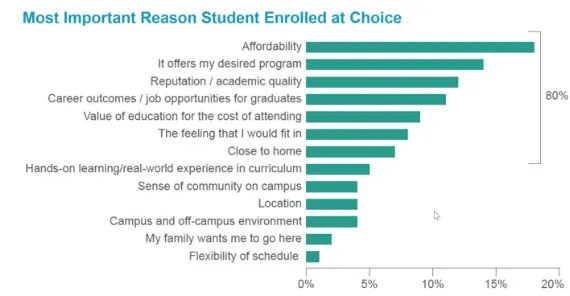
The table below illustrates the most important reasons students enroll in the college of their choice. Affordability, the desired program, reputation, academic quality, career outcomes, the value of education, feelings of fitting in, and being close to home were the most important reasons students enroll in their desired programs.
Media literacy is a core component of decision-making, as students will often consult internet resources, discuss information with friends and family, and use social media to make their decisions. Students need to be fluent in all forms of media and communication. Their ability to research and investigate the school of their choice will also translate to job search success and being a productive member of society. These real-world applications are beneficial and invaluable.
Colleges must be aware of the values students are seeking so they can tailor their content to them and ensure that their offerings meet students’ needs. This enables media literacy to be an invaluable tool for determining how to create and communicate content, making the transactional relationship between service providers and consumers more of an open dialogue and beneficial for both parties.
Media literacy advocates for better communication for everyone and benefits society. Teachers must give students the skills needed to increase their digital aptitude, absorb these skills, and know what tools are available to them. These skills are invaluable in school and college environments, as well as in the workplace and beyond. The relationships between each stage of a student’s education and life are all connected. Educators can leverage the principles of content creation and engagement to ensure that students become active and productive members of society.

 The Mhelting Pot
2 thoughts on “How students benefit from media literacy education”