
Now that we have defined the framework for digital content creation and its importance, how can teachers best educate their students about the subject? How can teachers articulate its value to students and equip them with the skills needed to increase their knowledge and understanding?
According to the California Department of Education, the requirements exist “…to ensure that young adults are prepared with media literacy skills necessary to safely, responsibly, and critically consume and use social media and other forms of media…Understanding and teaching media literacy is the responsibility of all educators. Media literacy is best learned and practiced when integrated into the school’s curriculum. Classroom teachers can work with teacher librarians [to explore] this collection of resources to develop media-rich contextual learning activities.” Schools and teacher curricula are already beginning to incorporate important lessons and skills around multimedia information. This is a positive step in the right direction that can be enhanced with additional teacher support and resources.

Tips for teachers to spread the word on media literacy
The New York Times describes five useful tips to reduce the spread of misinformation and help advocate the importance of media literacy. These include:
- “Get the big picture: What is media literacy education? Why do we need it?”
Teachers must illustrate the importance of digital content awareness by communicating its value to students in their daily lives. The skills must be applicable outside of the classroom and enforced through interactions on the Internet, social media, and more. - “Have students share their experiences and opinions — and offer adults advice.”
While teachers may be responsible for teaching digital awareness, they must also be receptive to student feedback. The exchange of ideas and information reduces knowledge gaps and encourages meaningful improvements. - “Learn from teen fact-checkers.”
The Teenage Fact-Checking Network is described as a resource that publishes fact-checks for teenagers by teenagers. The network practices analytical reasoning and encourages outside research for teenagers. - “Invite students to investigate your school’s media literacy offerings and make recommendations.”
With more schools creating programs around this topic, teachers can invite students to impact the offerings. Working directly with students to assess what’s working and materials that may require improvement is vital for ensuring the program’s success and educating future generations. - “Help students ‘access, analyze, evaluate, create, and act’ with these additional resources.”
Lastly, the New York Times article lists additional resources supporting critical thinking principles, as defined by the National Association for Media Literacy Education (NAMLE). These resources include The News Literacy Project, Common Sense Education, News Decoder, and more.
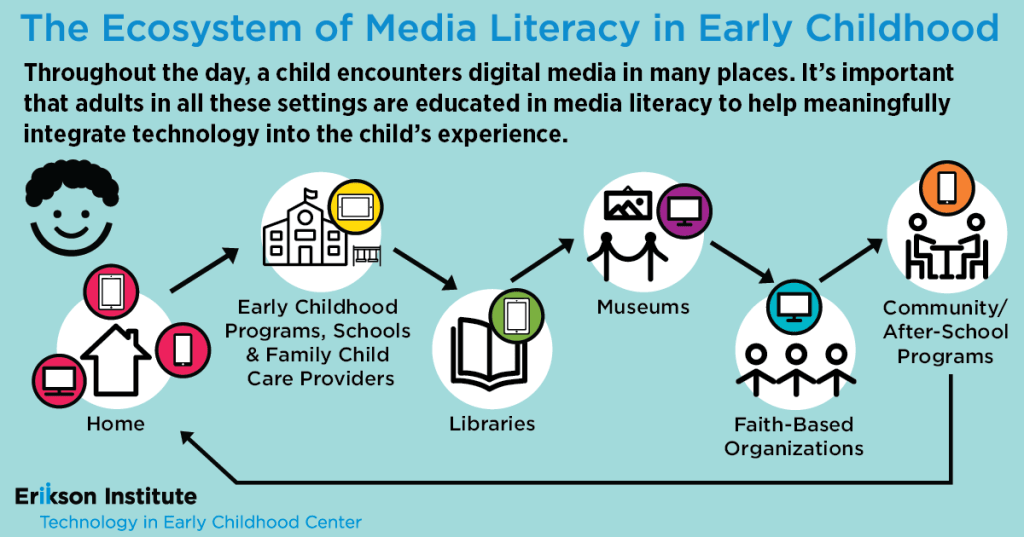
It is also essential for adults to understand the network of communication and information in early childhood development. As the diagram below illustrates, children navigate multiple ecosystems that impact their digital aptitude. Adults can leverage this information to safely integrate technology into a child’s life and, importantly, the skills to navigate the information.
Examples of how teachers can teach media literacy in practice
With recent advancements in generative artificial intelligence and the ease with which misinformation spreads through social media, students need to be taught how to identify AI content and fake news. Teachers have a unique opportunity to teach these skills through various exercises. Examples include:
- Teachers can give their students examples of real and fake news articles and ask them to assess them, research the story, and provide their reasons and justifications for distinguishing between fact and fiction.
Variations of this exercise can include asking students to research a real news story and create a fake one and setting up partnered groups to assess each one. - Teachers can provide students with a series of images featuring human-created art versus similar AI-generated content. Students would identify the problems with the pieces and the components that reveal which one is human or AI-generated. This exercise can also be performed with writing.
This allows students to practice visualizing the difference and identifying giveaways in other contexts. For example, students can be taught to look for inconsistencies and repetition in writing or warped backgrounds and distorted anatomy in images. For more information on how to spot AI-generated content, visit the Capitol Technology University website.
Canva describes several additional creative examples for teachers to pursue. Other suggestions a teacher could explore include creating mind maps for multiple sources of information, writing exercises to practice gauging language and tone, and developing media to help understand biases and facilitate critical thinking. Teachers can integrate these exercises into their curriculum to help students understand the importance of research and critical analysis. The principles of digital literacy align with the skills honed in each exercise: use, understanding, and engagement. Media literacy requires active thinking and consideration to be complete and holistic.

 The Mhelting Pot
2 thoughts on “How teachers can educate on media literacy”